
To address this question, it is helpful to establish several theological principles. Every promise of God is received through obedient faith in Jesus Christ. “For all the promises of God in Him are yea, and in Him Amen” (2 Corinthians 1:20). Christ is also described as “the Lamb slain from the foundation of the world,” and Scripture declares, “Of Him, and through Him, and to Him, are all things” (Romans 11:36).
Faith is inseparable from works, and its character is demonstrated through testing. Such testing involves a moral choice between obedience and disobedience. As Scripture states, “To whom ye yield yourselves servant to obey, his servant ye are to whom ye obey; whether of sin unto death, or of obedience unto righteousness” (Romans 6:16). Similarly, “Abraham believed God, and it was accounted unto him as righteousness”—understood here as the righteousness of God in Christ Jesus.
Eternal life is presented as a promise of God made before the foundation of the world (Titus 1:2). On this understanding, it was ordained before Adam’s creation and, like all God’s promises, was to be received through obedient faith. Adam’s faith in God’s supremacy was therefore to be demonstrated through obedience. As an heir of the promise, he was required to acknowledge God’s sovereignty in both belief and action. As Scripture says of Christ, “Though He were a Son, yet learned He obedience by the things which He suffered.” Adam, however, failed the test of obedience.
The last Adam, the Lord Jesus Christ, succeeded where Adam failed. In the wilderness, Jesus was tested three times by the Devil, responding each time with an appeal to God’s command: “It is written.” Scripture subsequently records, “The Devil … parted from Him for a season” (Luke 4:13), indicating that the testing would continue. As His final trial approached, Jesus reminded His disciples: “The prince of this world is coming. He has no hold on me, but the world must learn that I love the Father and that I do exactly what my Father has commanded me” (John 14:30, NIV).
That final testing reached its climax in another garden, Gethsemane. There Jesus submitted Himself fully to the Father’s will: “Take this cup from me: nevertheless not my will, but yours be done.” His submission expressed His commitment to pleasing the Father despite the suffering before Him. Within this argument, Gethsemane represents a necessary step preceding His exaltation. Had Adam likewise resisted Satan’s temptation and remained faithful to God’s command, his obedience would have led to righteousness with God, in accordance with the principle stated in Romans 6:16.
Abraham offers a further contrast to Adam. When tested, he remained steadfast in faith, trusting that God could raise Isaac from the dead. Through faith, Abraham acknowledged God’s lordship and power over death, submitting to the command, “I am God Almighty; walk before me and be blameless” (Genesis 17:1). Righteousness was therefore imputed to him. His agreement with God is presented as the basis of fellowship with Him: “Can two walk together except they be agreed?” This connection between obedience and friendship is also expressed in Jesus’ words: “Ye are my friends if ye do whatsoever I command you. Henceforth I call you not servants; for the servant knoweth not what his master doeth” (John 15:14,15). In keeping with this principle, God disclosed His intentions concerning Sodom to Abraham: “Shall I hide from Abraham that thing which I do?” (Genesis 18:17).
Scripture further distinguishes Adam’s created condition from the immortal life manifested in Christ: “The first man Adam was made a living soul; the last Adam was made a life giving spirit” (1 Corinthians 15:45). Verses 47–49 likewise contrast the earthly first man with the heavenly second man and point to the immortal nature of Christ’s resurrected body. Adam, by contrast, was formed from the earth. God’s judgment states: “In the sweat of thy face shall thou eat bread, till thou return unto the ground; for out of it wast thou taken: for dust thou art, and unto dust shalt thou return” (Genesis 3:19). The declaration that “flesh and blood cannot inherit the kingdom of God” further supports the argument that humanity must be transformed into a condition suited to eternity.
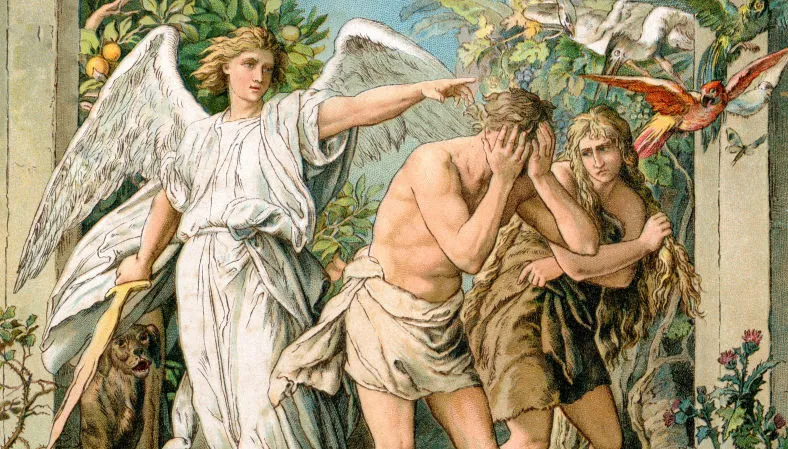
Genesis 3:22–23 provides additional support for this interpretation: “The Lord God said, Behold, the man is become as one of us, to know good and evil: and now, lest he put forth his hand, and take of the tree of life, and eat, and live forever: therefore the LORD God sent him forth from the Garden of Eden, to till the ground from whence he was taken.” On this reading, Adam did not possess eternal life inherently at creation. The words “take of the tree of life, and eat, and live forever” connect everlasting life with access to the tree of life. This interpretation holds that Adam had not yet obtained that life.
The same principle appears in Revelation. Jesus says, “To him that overcometh will I give to eat of the tree, which is in the midst of the paradise of God” (Revelation 2:7). Again, “Blessed are they that do his commandments, that they may have right to the tree of life” (Revelation 22:14). Thus, the right to the tree of life—and therefore to eternal life—is associated with obedient faith in Christ and the acknowledgment of His lordship.
In conclusion, the interpretation presented here is that Adam did not possess eternal life by nature at creation. Rather, eternal life was God’s promise from before the world began, to be received through the obedience of faith in the Son of God.
Have questions or comments
Please use the form to the side